
About
Preset for the Outlook meetings feature can be defined for all kinds of meetings.
There will be settings marked with EDITABLE BY THE USER and NOT EDITABLE BY THE USER .
-
editable by the user means the user can change and adapt specific options. For example, an admin can set the template (message content) for an email, but the user can modify that content when using the preset in Jira. It does not mean there are separate settings options for the user.
-
not editable by the user means the user cannot change this setting. For example, a Preset’s name, icon, and built-in automations cannot be changed, even if the user selects and uses the preset in Jira. These settings are set exclusively by the Jira admin.
Learn more about the configuration process below.
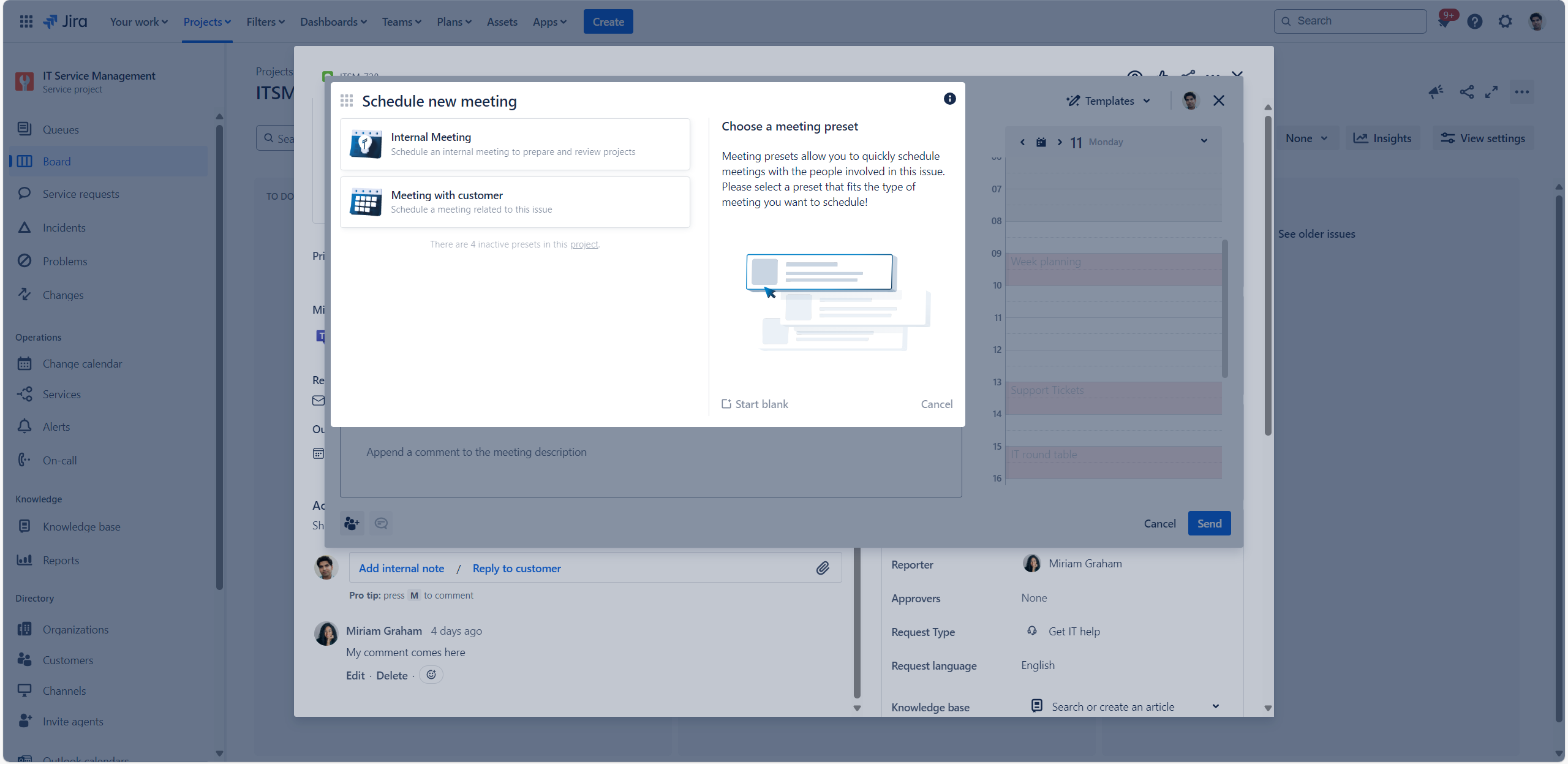
Configure a Preset for Outlook meetings
Click through this short demo to configure a Preset for your Outlook meetings.
Preset settings
Preset blueprints
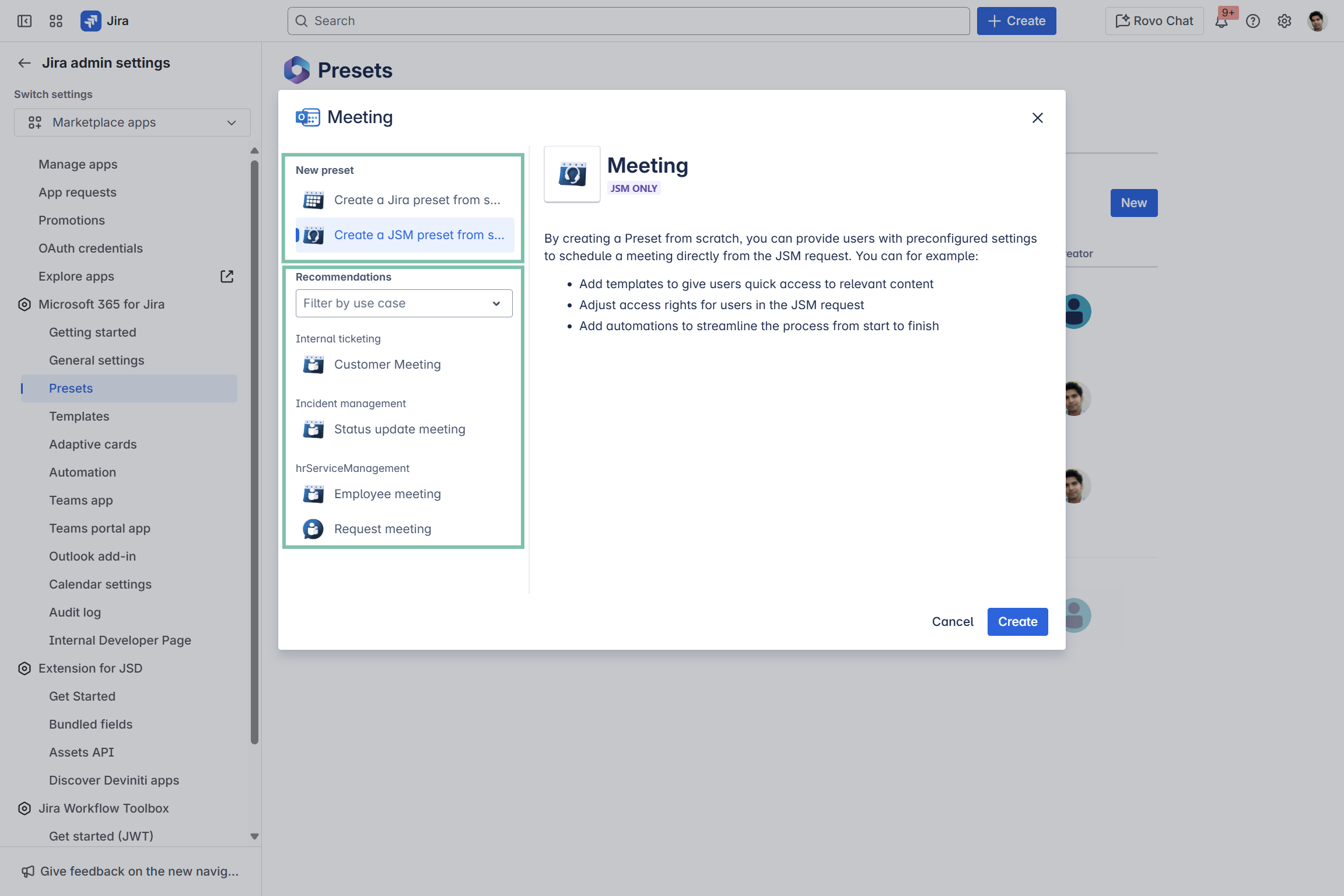
You can create presets from scratch (first two options) or from a preconfigured blueprint (see options below under “recommendations”). Blueprints are available for specific use cases, such as incident management and internal ticketing.
Meetings Preset blueprints provide pre-filled configuration options for:
-
(Meeting) title and description
-
Date and time (start and end dates)
-
Attendees
-
Response options
-
Access options (sharing)
-
Dialog configurations (e.g. advanced mode)
-
Built-in automations
You can adjust or accept these options.
When creating a Preset, you can choose between a JSM or Jira project. Configuration options differ based on the Preset type.
Preset framework
not editable by the user
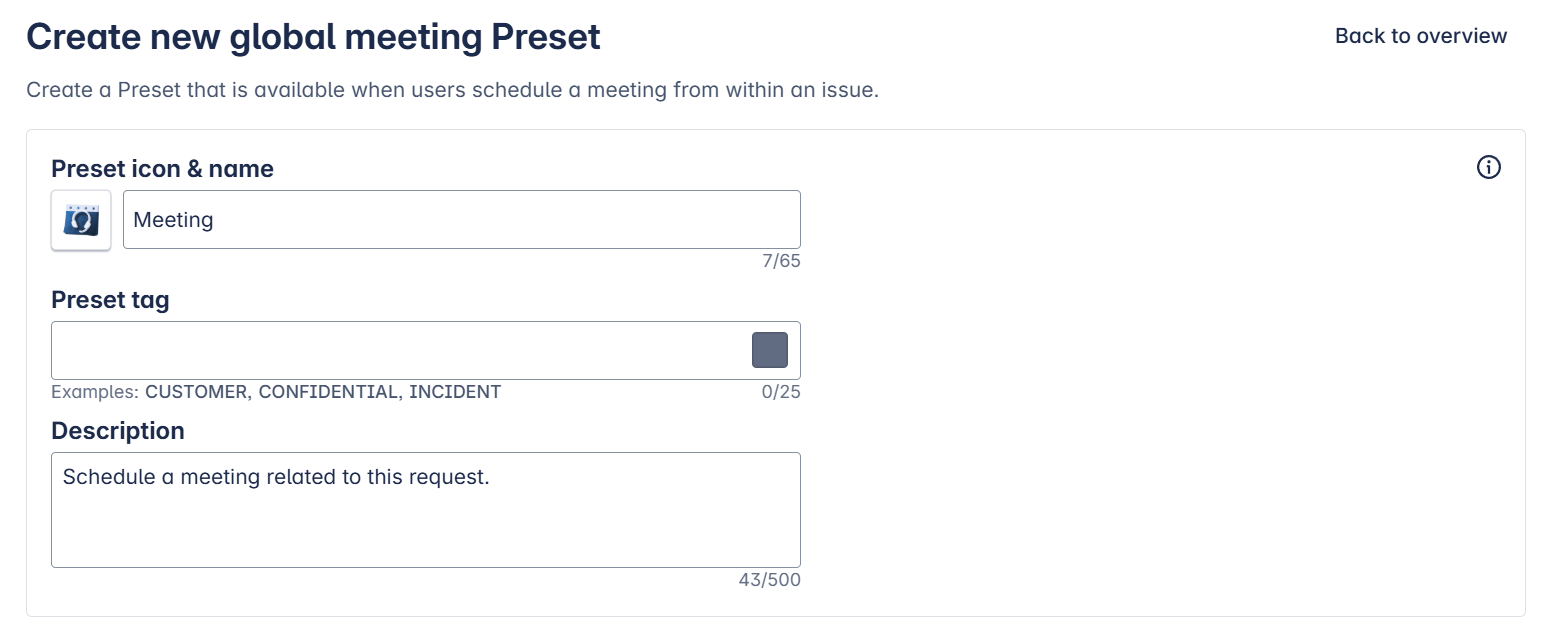
When selecting a Preset option, decide on a name & icon, a tag and add a short description.
|
Preset icon & name |
Choose a specific name and icon so that users understand the usage of the Preset. |
|
Preset tag |
Use tags e.g. “internal” / “external” / “sensitive” etc. to categorize the Preset for the user. |
|
Preset description |
Be as precise as possible to distinguish easier among your Presets. |
Meeting settings
To access attendees options you must log in with your Microsoft 365 account via this button on the bottom of the page. 
editable by the user
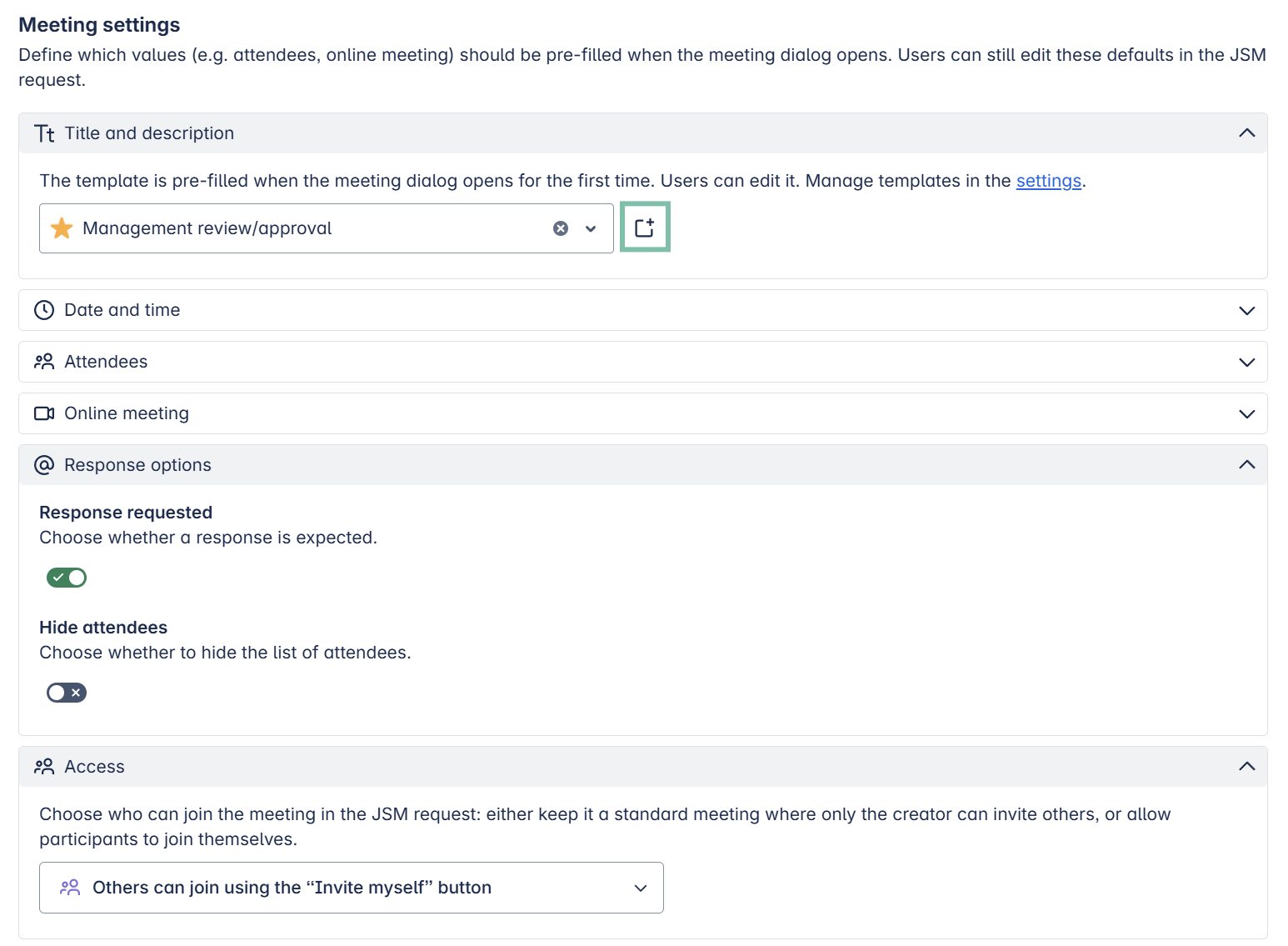
Decide on the title and description of the meeting, attendees as well as the start and end date and access options.
not editable by the user
If a response is required or attendees should be hidden, is a setting only the Jira admin defines here and which is not editable in Jira later.
|
Title and description |
Give the Preset a name and choose among existing meeting templates which content should be prefilled when choosing a Preset in Jira. Create a global Preset:
Create a project specific Preset:
Create a new template:
|
|
Date and time |
Define a specific start and end date based on Jira fields or decide if it this Preset should be an all day meeting. By default, our app recommends a start date based on attendee’s calendar availability. |
|
Attendees |
Static user: Search by email for a required persons.
|
|
Online meeting |
Define if the meeting should held online only. |
|
Response options |
Response required: Choose if a response to the meeting invitation is necessary.
|
|
Access |
Decide whether to keep the meeting private or make it public.
|
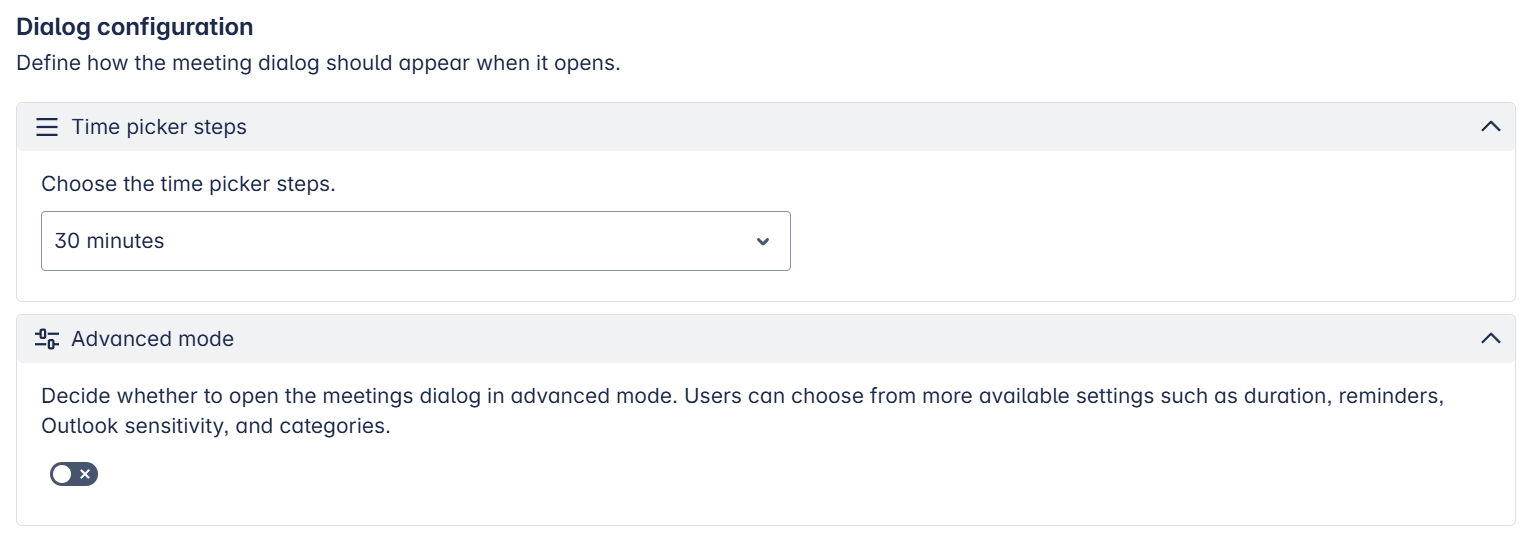
Dialog configuration
not editable by the user
Decide, if the meetings dialogue should open in advanced mode and choose time picker steps.
|
Time picker steps |
Select the intervals at which our app should propose meeting time suggestions. |
|
Advanced mode |
Decide if the user should have even more options to select from when scheduling the meeting e.g. Outlook sensitivity and categories. |
Built-in automations
not editable by the user
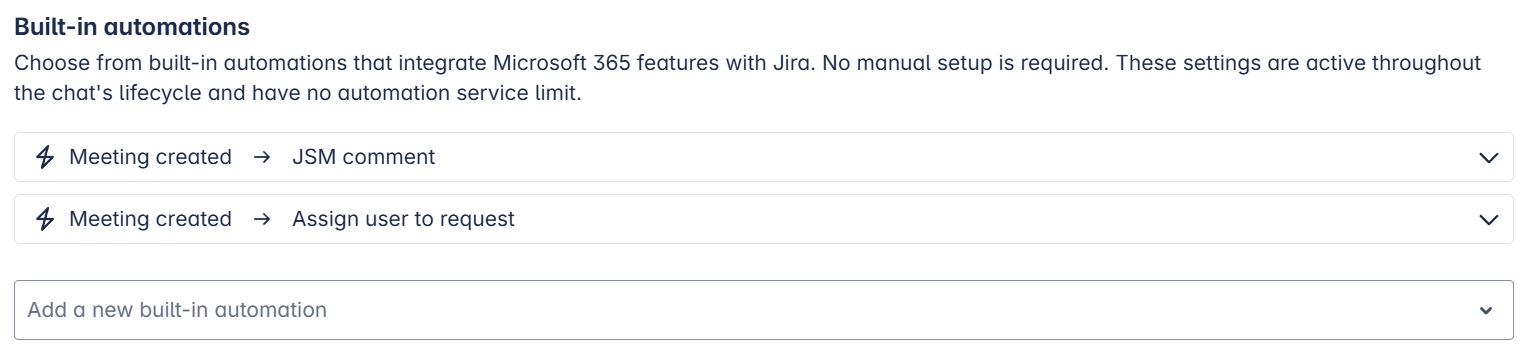
Choose from built-in automations that integrate Microsoft 365 features with Jira and make workflows more efficient in Jira and/or JSM projects. No manual setup is required. These settings are active throughout the meetings lifecycle and are not running into Atlassian's automation run limits.
JSM projects
|
|
|
Meeting created
|
Attach a comment to the request, when a new meeting is scheduled. All involved persons will be notified via email. Jira comment visibility:
|
|
Meeting created
|
The agent that creates this meeting will be automatically assigned to the request, provided they have the necessary permissions to assign themselves. |
|
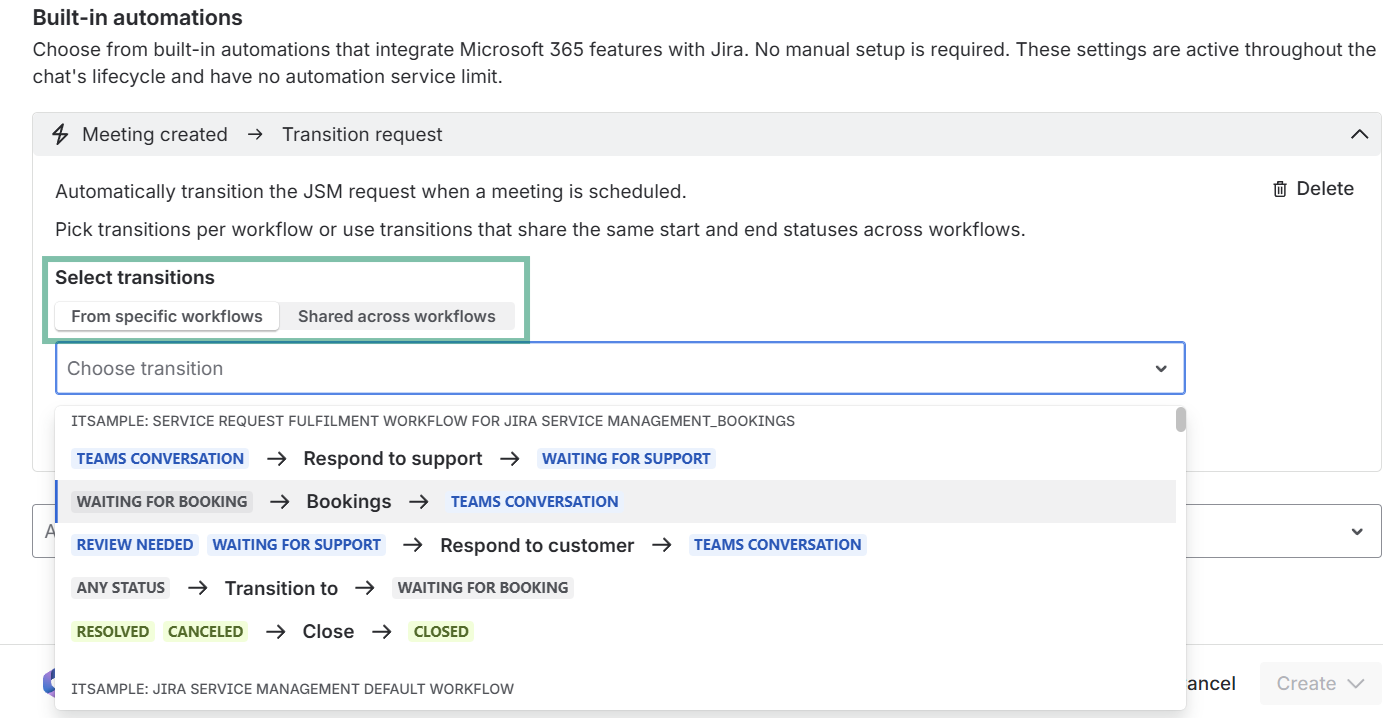
project specific
|
When a meeting linked to a JSM request is created, the rule triggers a predefined workflow transition on that request. Choose which transitions to use when the meeting has been created. You can:
Please note:
|
Jira projects
|
|
|
Meeting created
|
Attach a comment to the work item, when a new meeting is scheduled. All involved persons will be notified via email. |
|
Meeting created
|
The user that creates this meeting will be assigned to the issue, provided they have the necessary permissions to assign themselves. |
|
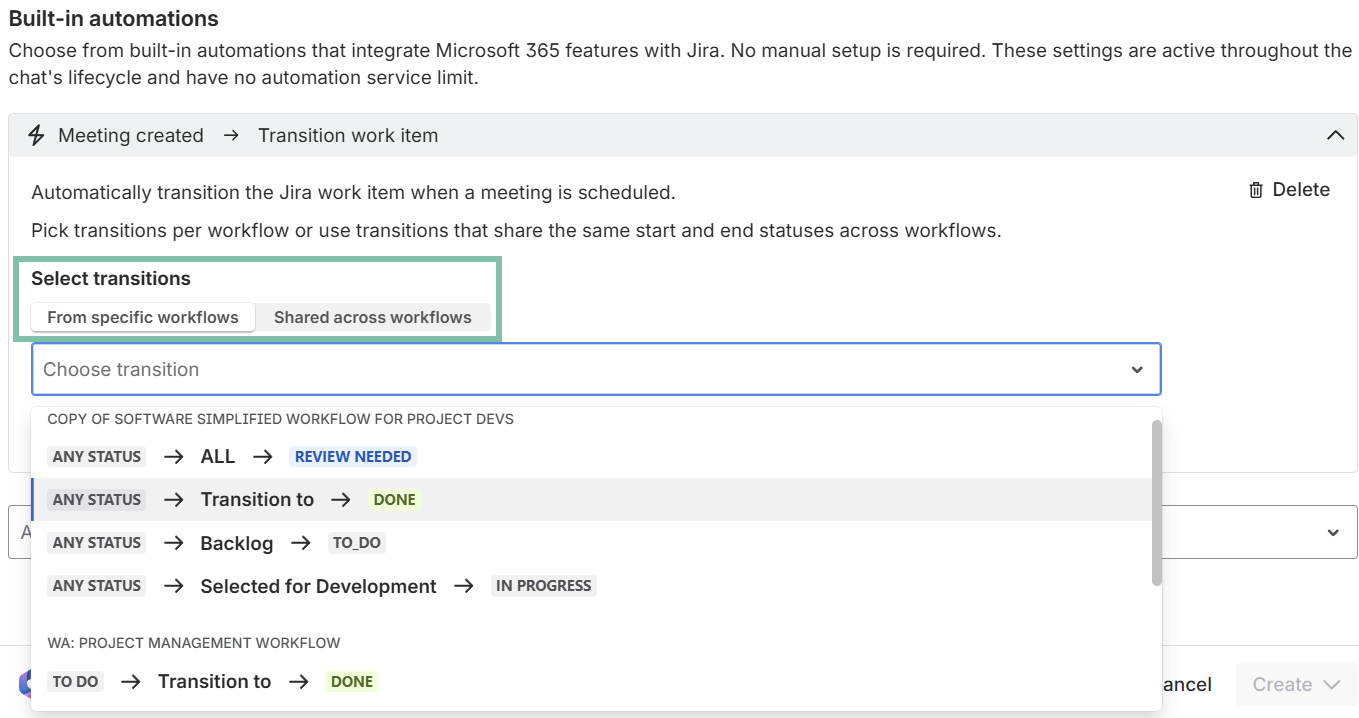
project specific
|
When a meeting linked to a Jira work item is created, the rule triggers a predefined workflow transition on that request. Choose which transitions to use when the meeting has been scheduled. You can:
Please note:
|
Built-in automation: Transition request/work item
The following explanation is based on the Teams preset.
-
Select one or more transitions from specific workflows and have them also listed in the shared across workflows tab, if the selected ones also exist in other workflows.
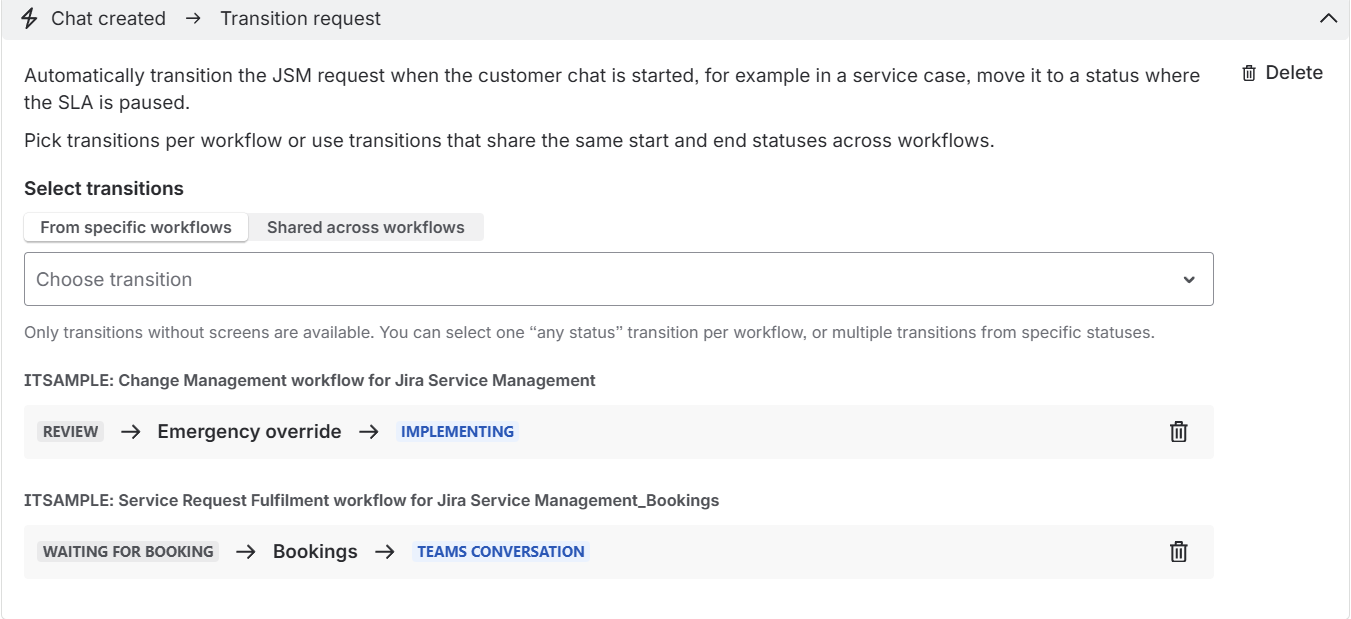
-
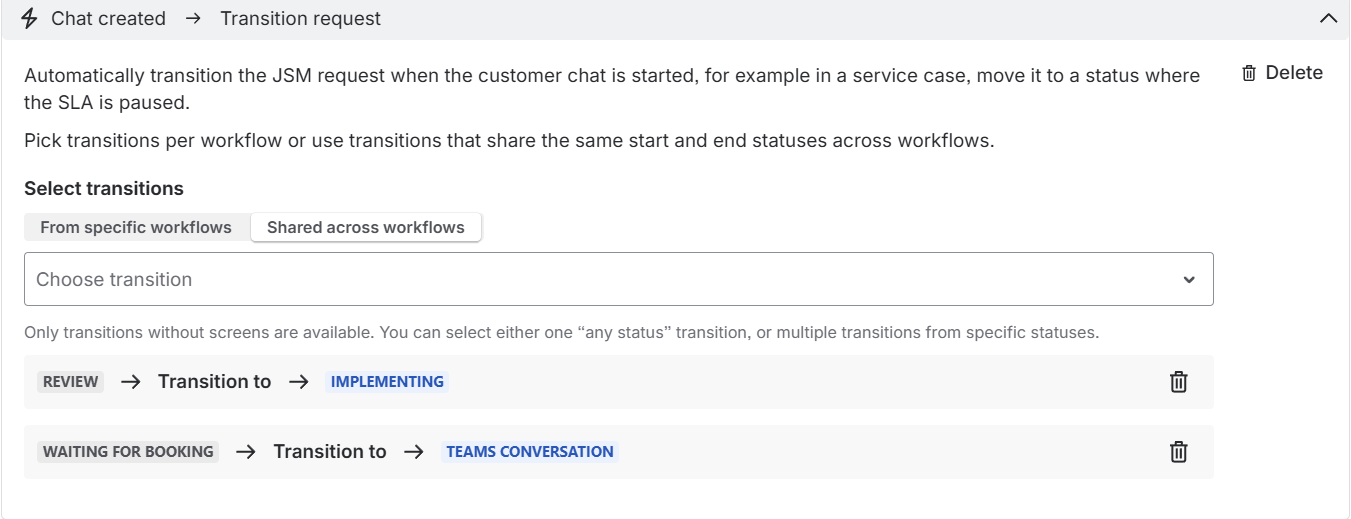
Start by selecting transitions which are shared across workflows. Switch to the tab for specific workflows to see all workflows containing the selected transition. Delete or keep transitions, if desired.
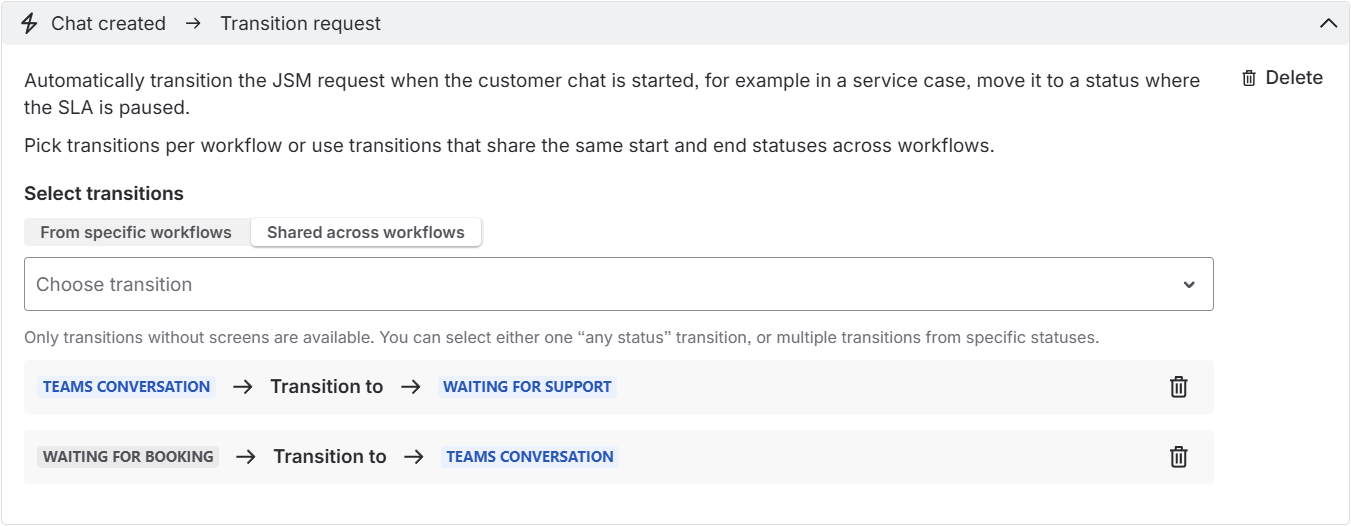
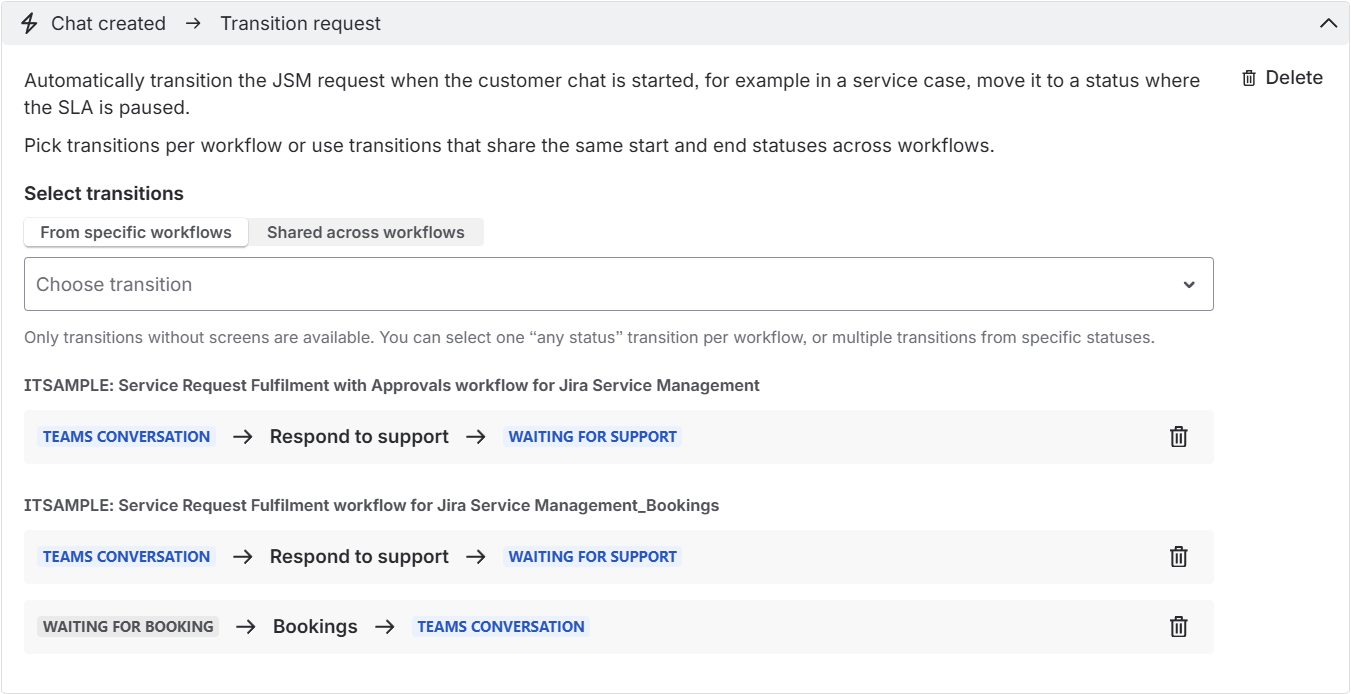
Please note:
Whenever there is an “any status”-transition selected, no other transition can be selected in this workflow.
If you want to set up more advanced Jira automation rules with Microsoft 365, click here.
Finish set-up
not editable by the user
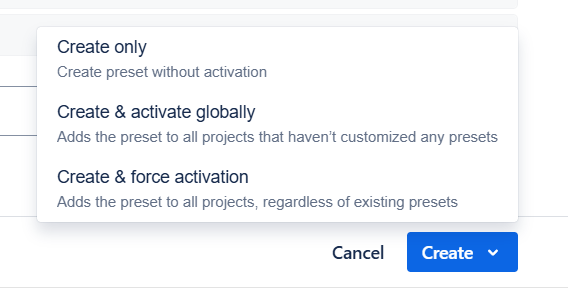
When finishing the set-up of the Meetings Preset, you can decide between different activation options.
|
Create only |
Create the Preset and it will be available in the admin / project settings in Jira. It needs to be manually activated via the settings. |
|
Create + activate globally |
Create and activate the Preset and it is automatically active in all Jira projects with no project-specific settings. 📌 Please note: If there are project specific settings, the project admin still needs to activate the Preset manually via the project settings. |
|
Create + force activation |
Create and activate the Preset and it is automatically active in all Jira projects regardless of project-specific settings. 📌 Please note: Project specific settings will be overridden and the Preset will automatically be available and selectable in the Jira issue. |