
We’re adopting the new Atlassian Design Guidelines. This helps users which are new to Jira to feel right at home and fields can be filled out even more intuitively.
Our Outlook add-in lets you create new work items based on scheduled meetings. Moreover, you can add even meetings to exiting work items, if they contain relevant information for the project.
When creating a new work item, text formatting such as lists, colors, and tables are automatically taken over.
The interface is similar to Jira, allowing easy navigation. You can fill out necessary fields in Outlook, and your meetings content will be converted to Jira markup.
Sure, you can also add meetings/meeting information to existing work items and you can search for related work items based on present meeting information (sidebar).
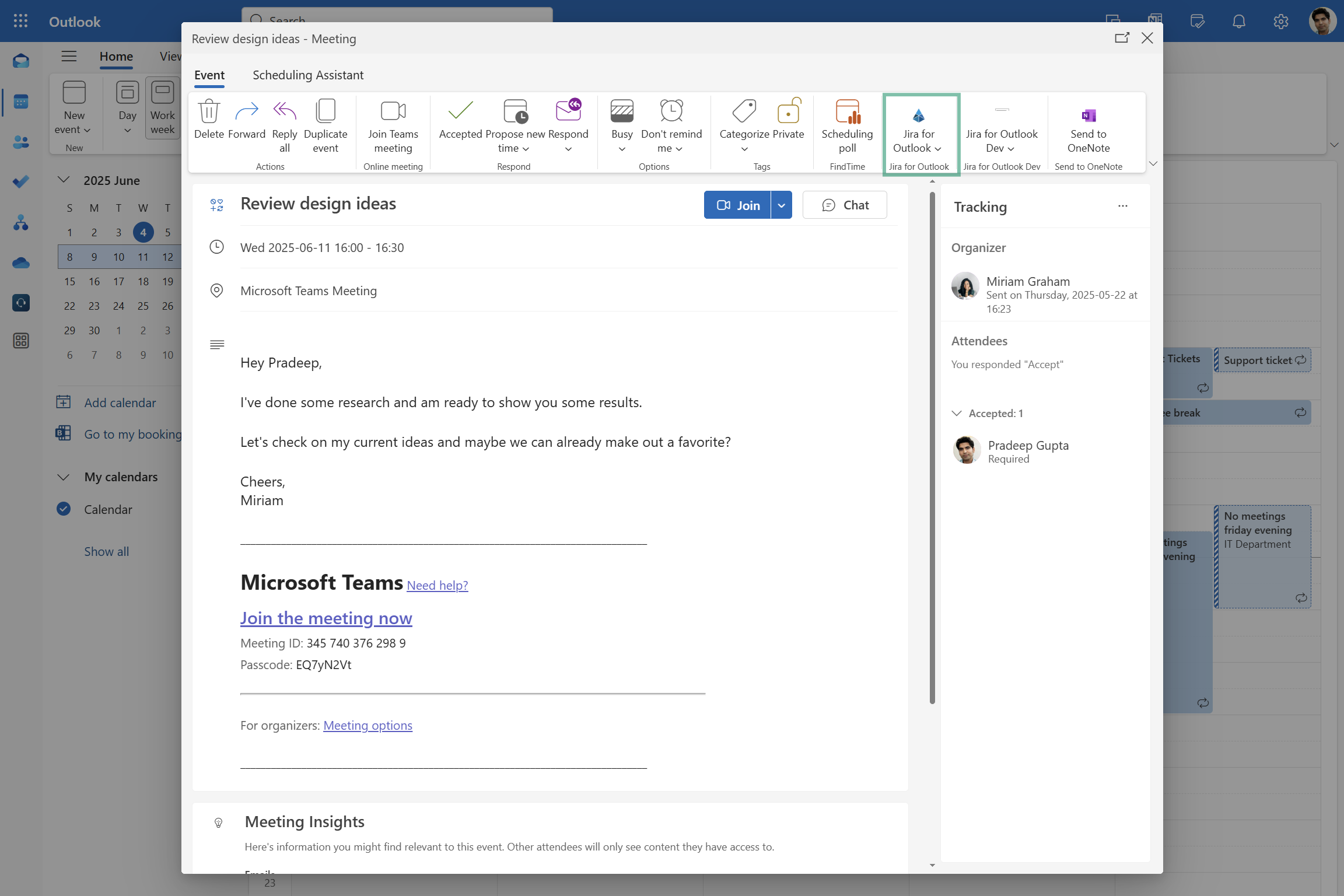
Feature at a glance
Some meetings require support from technical co-workers mainly working in Jira or they involve outcomes relevant to specific projects and their progress.
Thus, it can be helpful to bring those meeting information to Jira by creating new or adding them to existing work items.
Create new work items based on Outlook meetings
Select a meeting of your choice and open the Outlook add-in at the top of the screen to create a new work item based on the meeting information.
Any custom fields defined in Jira are automatically taken over by the Outlook add-in. Some third-party apps (e.g., Tempo Timesheet or Jira Portfolio) are not supported: Supported custom fields
The dialogue/drop-down shows all Jira projects you have access to.
Based on the selected project type, all related work item types are provided.
Depending on the work item type selected, the add-in will automatically update the parent work item field according to the work item hierarchy (e.g. the parent work item “epic” will show when the work item type “task” is chosen).
The parent of your task enables you to search for keys or descriptions that are filtered according to the selected project.
Share meeting information in Jira
A shared meeting is linked to your MS 365 login. Other users will see it as you do. Logging out may break visibility for other Jira users.
If the user opens the Outlook add-in for the first time (e.g. new issue screen) they need to log-in with their MS 365 account first, in order to select from the sharing options provided (see screenshot below.
ℹ️ To log in, the “share meetings” toggle needs to be turned on in the first place.
☑️ Sometimes, the user can choose from the sharing options directly, if they are already logged in from Jira.
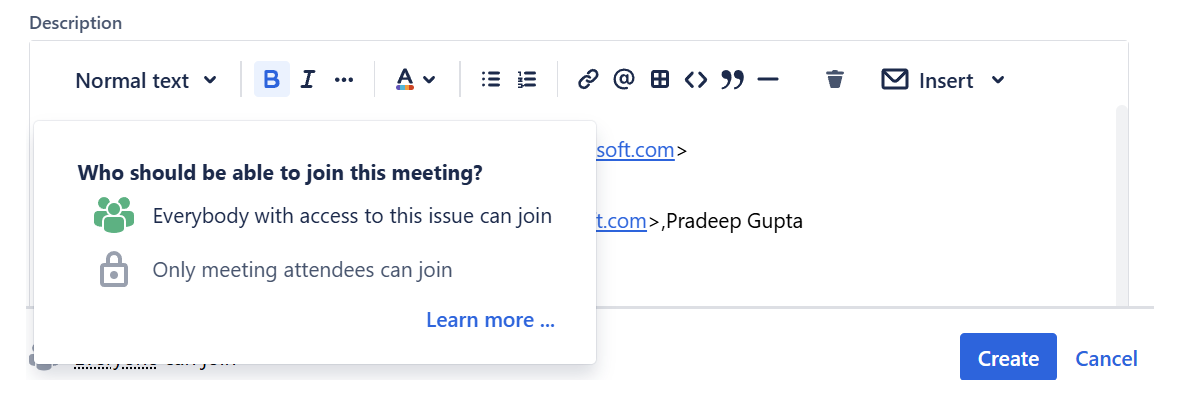
In Jira, the meeting will appear as a new work item to your board including all meeting details in the related meetings panel.
Learn more below about why the Microsoft 365 log-in is highly recommended / required.
Please note: When using the email feature in Jira, sharing and accessing email content is unavailable for Outlook exchange on-premise hostings. However, you can still use our Outlook add-in for the Outlook features.
Why is a Microsoft 365 log-in required?
Sharing options from Outlook rely on a Microsoft 365 log in. Otherwise, it cannot work properly and the feature cannot be used to its full extent.
📍 Benefits and requirements:
-
Create issue (from an Outlook meeting): sharing meetings enables teams to access the same level of information in Outlook and Jira. A shared meeting appears as an individual work item including all meetings details. Thus, even users with no access to Outlook can join and follow up on the communication and meeting outcomes.
-
Image display (create issue): If not logged-in, images cannot be displayed properly in the description field when creating the work item from Outlook. Previews might not be available. However, the images will be displayed correctly in Jira (after creation).
See Jira label in meeting request
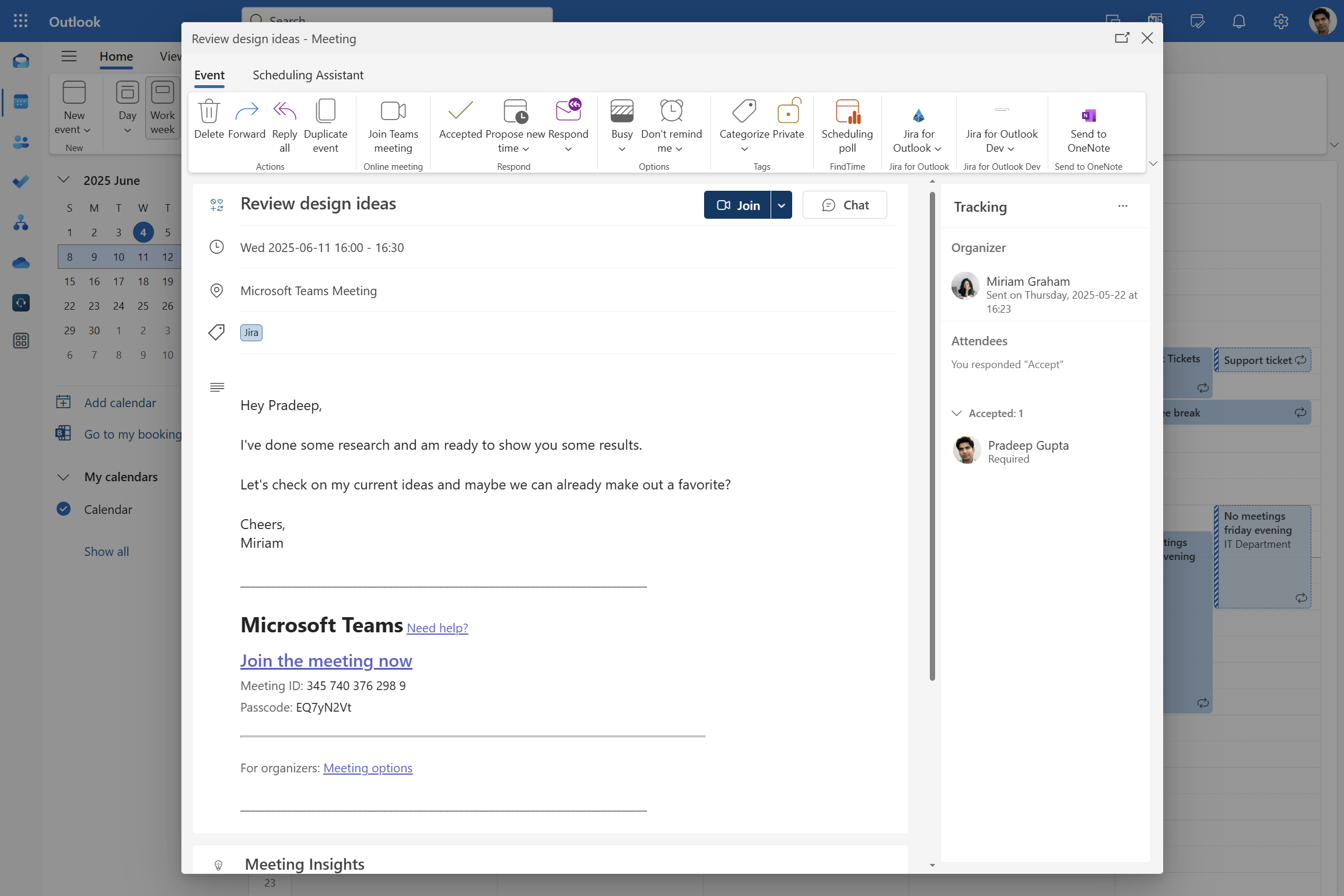
Once the work item is created based on the meeting information, a small “Jira” label appears as a tag in the meeting details, helping you to quickly identify conversations with corresponding work items in Jira.
Sure, the work item can now be found in the sidebar in Outlook, as well.
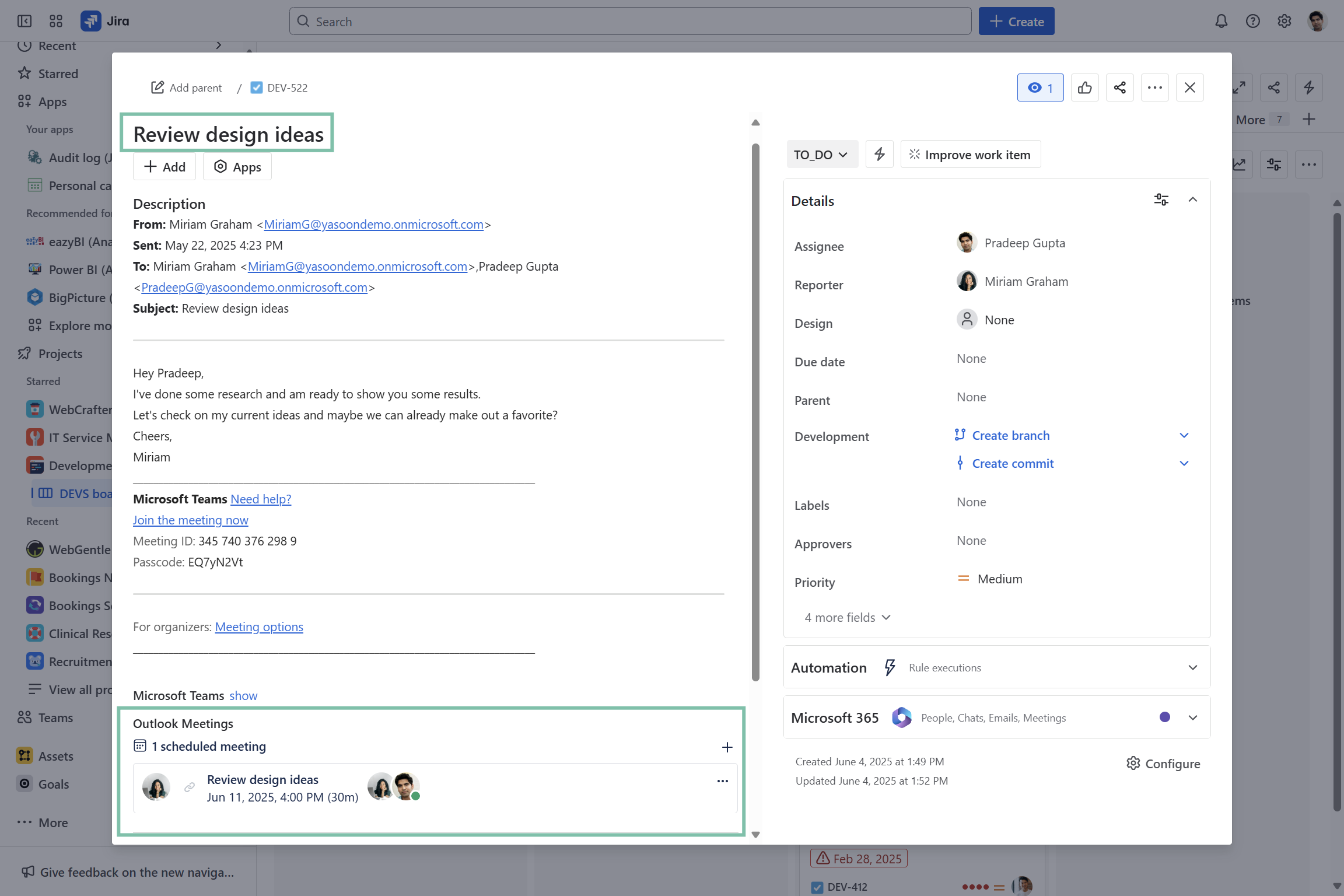
Access meeting information as a new work item in Jira
When checking tasks in Jira, the team will find the new work item accessible on their board, complete with the same details as those in Outlook.
The description field displays the meeting information, while the meeting details, including time and date, are shown in the “related meetings panel.”
As the meeting approaches, a blue "join" button will become visible, enabling users (as outlined in the sharing options from Outlook) to access and join the meeting directly from the work item.
Add scheduled meetings to existing work items
Projects evolve and sometimes information about meetings need to be linked to other work items in order to maintain a good level of transparency and information clarity across the team.
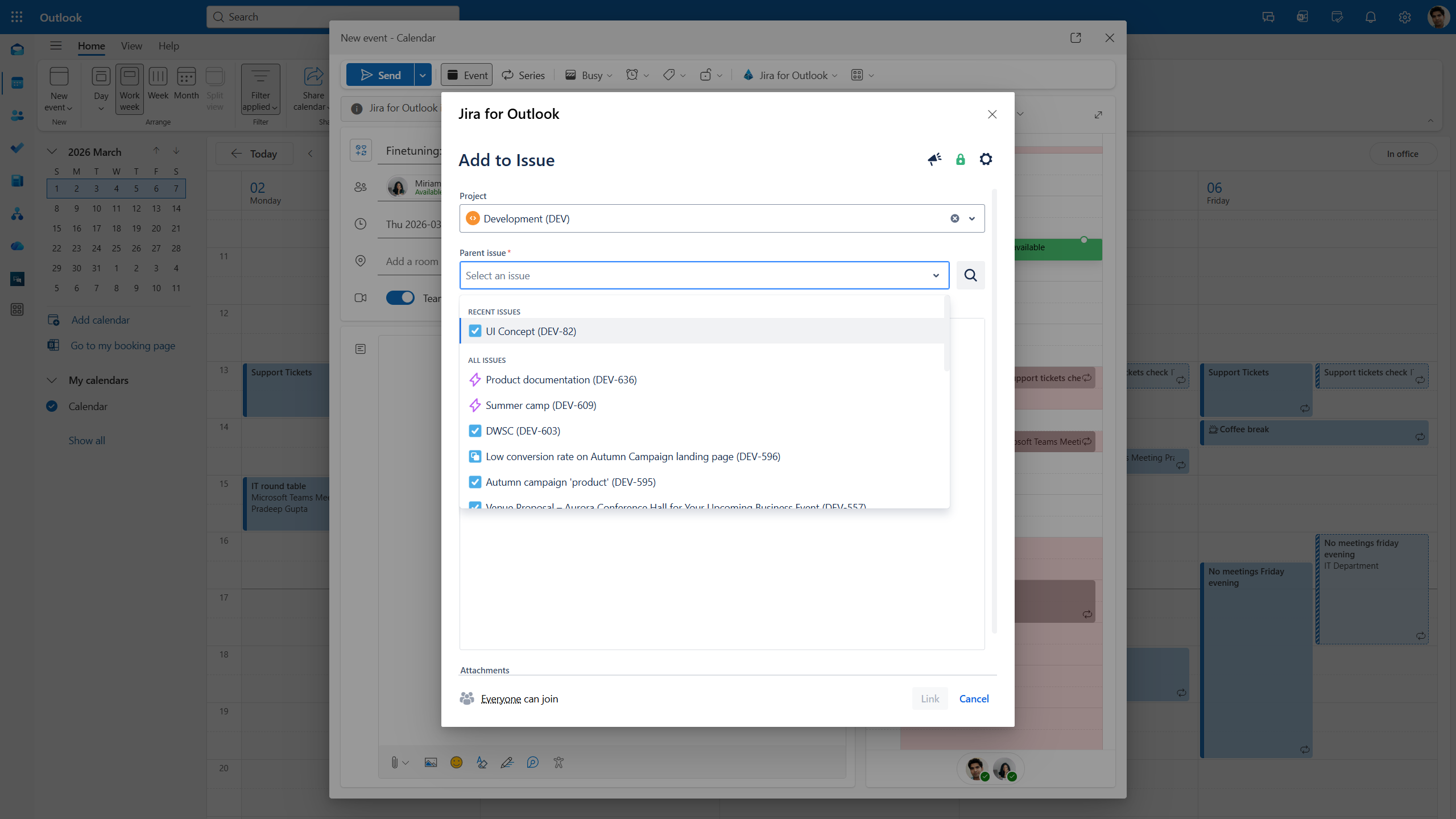
Scheduled meetings and their outcomes can influence the process of other projects or can form the basis for new ones. Either way, once an existing meeting is added to an existing work item, the information is saved in one place and accessible for the team in Jira. Team members can join the meeting, if permitted (see screenshot below).
If configured in the dialog settings of the add-in, it will automatically suggest the most recently used project and work item type. However, you have the flexibility to modify these selections as needed.
Select an appropriate project and parent work item from the dropdown menu, then add the meeting to an existing context in Jira.
Use the “magnifying glass” to refine your search, if the relevant work item does not appear in the drop-down menu.
Sharing options: Decide, if and who should be able to join the meeting, if information is shared to Jira. Learn more here.
Exception: recurring meetings
Recurring meetings are an exception: they neither be added to existing work items nor can they be imported to Jira as new work items.
Feature configuration
To use Jira features in Outlook (like creating Jira issues from meetings), a connection between Jira and Outlook must be established by your Jira and Microsoft admin (refer to: Admin configuration).
Admin configuration
To get started, the installation and deployment of our Outlook add-in (free) is necessary.
This task should be carried out by the Jira admin and Microsoft admin:
-
The Jira admin needs to prepare the set-up.
-
The Microsoft admin deploys the add-in centrally to all users/team.
The installation process is straightforward and can be completed in a just a few clicks by following the instructions available within the Jira admin settings (in the first place).
User configuration
Main configuration can be done via the Outlook settings by the user.
Useful links
-
Further information as well as the technical reference on shared office items can be found here: https://support.yasoon.com/M365FJ/sharing-access-to-microsoft-365-items
-
Interested in managing emails within Jira? This functionality is available without specific prerequisites: https://support.yasoon.com/M365FJ/emails-see-send-emails-from-within-jira
-
Detailed explanation of the sharing options from Jira can be found here under “Feature at a glance”: https://support.yasoon.com/M365FJ/emails-see-send-emails-from-within-jira#Emails:WorkwithemailsinJira-Featureataglance
-
-
Interested in managing your emails within Outlook? Check out your possibilities and bring emails seamlessly to Jira: https://support.yasoon.com/M365FJ/create-new-jira-issues-in-outlook